
The Independent Strategic Authority of Africa's High-Road Fashion Value Chain Industrial Economy
Established in 2016 to address the structural gap across the continent: the absence of sovereign, expert-led institutions capable of driving consistent industrialisation beyond political cycles.
WHAT IS THE EXECUTIVE COMMISSION?
The Commission is a neutral and independent institution of GFVC Africa and its constituent entities, serving as the organisation's executive coordination arm.
GFVC Africa was established in 2016 in response to Africa's persistent industrial underdevelopment, fragmented value chains, and the need for stronger independent institutions capable of advancing long-term industrial development. Our mission is to accelerate industrialisation, strengthen value chain integration, support enterprise growth, and expand productive economic activity across Africa, while contributing to the objectives of Agenda 2063, AfCFTA, and the Sustainable Development Goals.
Through the development of integrated industrial ecosystems, productive enterprises, and coordinated value chain systems, GFVC Africa seeks to build a highly competitive, inclusive, economically sovereign, and resilient GFVC Africa Economy. This economy strives for balanced growth, price stability, social progress, environmental protection, and financial freedom for all Africans, regardless of socioeconomic status.
INSTITUTIONAL POSITION
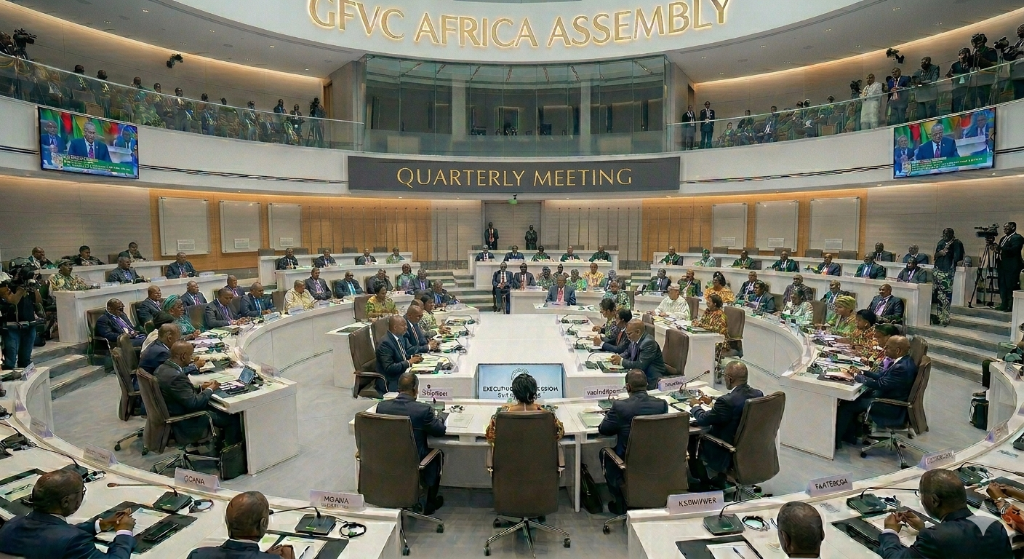
The Executive Commission occupies the central coordinating position within the GFVC Africa governance architecture.
Reporting to the Assembly, it translates continental mandates into structured frameworks, technical standards, and measurable development outcomes.
It serves as the strategic interface across the ecosystem — ensuring that policy direction, implementation systems, and financing mechanisms operate in alignment with a unified continental vision.
INSTITUTIONAL MANDATE
Legislative & Technical Coordination
Providing a unified interface for Pan-African policy alignment and structured engagement across all 54 member states and 8 RECs.
Sovereign Governance & Oversight
Ensuring compliance, accountability, and system-wide coherence across the entire GFVC Africa ecosystem.
Global Strategic Partnerships
Building alliances that translate into measurable economic outcomes — not symbolic agreements, but structured, accountable partnerships.
High-Road Financial Architecture
Guiding the development of continental financing frameworks aligned to industrial priorities and sovereign wealth retention.
Innovation & Programme Coordination
Enabling the structured rollout of ecosystem-wide industrial initiatives with measurable impact and accountability.
Made-In-Africa Framework
Positioning African production within a unified, high-value global identity — ensuring that 'Made in Africa' commands premium market positioning.
Pan-African Industrial Integration
Linking regional ecosystems into coordinated continental and global value chains — from raw materials to finished goods.
Competitive Value Chain Development
Advancing research, standards harmonisation, skills transformation, and market access across all 30 tiers of the value chain.
Strategic Direction & Vision
Defining the long-term trajectory of Africa's High-Road industrial economy — ensuring vision, policy, and execution remain aligned across generations.
STRATEGIC DIRECTION
To build Africa's single high-road industrial global fashion value chain economy — one that unites, transforms, respects ecological boundaries, and improves the well-being of all Africans.
To accelerate equitable industrial transformation through innovation, value addition, and coordinated continental integration.
HIGH-ROAD VALUES
Ensuring broad-based participation across all regions and communities.
Embedding environmental responsibility and institutional transparency.
Leveraging advanced technologies to remain globally competitive.
Driving quality and performance through Pan-African partnerships.
THE COLLEGE OF COMMISSIONERS
Governance Structure
The Executive Commission is governed by a College of Commissioners drawn from across Africa's regions and led by a President. The College defines strategic direction, policy priorities, and institutional oversight.
Commissioners are appointed by the Assembly for fixed terms, ensuring both continuity and renewal in leadership — institutional memory combined with fresh strategic perspective.
"The Executive Commission is the architect, regulator, and strategic guardian of Africa's High-Road fashion value chain industrial economy — ensuring that vision, policy, and execution remain aligned across generations."